How bilingual subtitles help language learning without breaking the viewing flow
A practical explanation of when bilingual subtitles help learners and when they become too heavy to read.
Learning
Bilingual subtitles help learners most when both lines stay easy to scan.
The value is not just seeing two languages. The value is seeing them in a stable, repeatable rhythm that still feels like a subtitle, not a study worksheet.
Key takeaways
Why bilingual subtitles help at all
Learners benefit because they can:
- compare the original line and target line at the same moment
- notice repeated phrasing patterns
- connect meaning to the pace of the scene
- rewatch a segment without juggling multiple subtitle tracks
That makes bilingual output more practical than opening two subtitle files side by side.
Learning workflow
When they become too heavy
Bilingual subtitles stop helping when:
- the scene is fast
- the cues are already long
- the line order changes constantly
- the viewer is forced to read two dense blocks at once
At that point, the subtitle stops supporting the scene and starts competing with it.
Use them for targeted study
The strongest pattern is usually:
- watch once with normal subtitles
- rewatch with bilingual subtitles
- pause and review repeated phrases
That keeps the bilingual version useful instead of exhausting.
Next step
Use the learning-focused subtitle route.
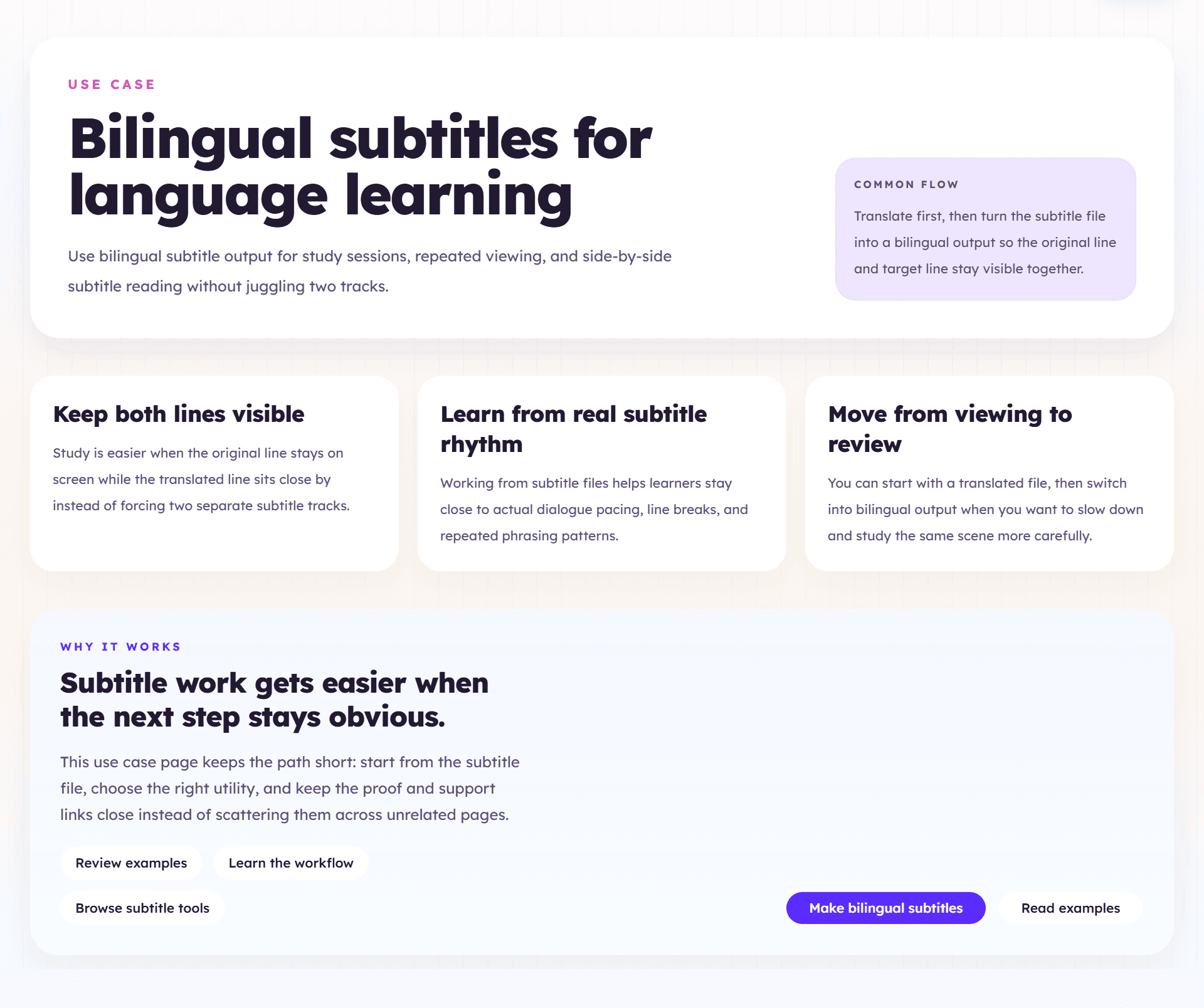
If your real goal is study rather than casual playback, the bilingual learning page gives you the cleaner path into that workflow.
View bilingual learning use case